Harding Township's homes sell for roughly a million dollars less than Short Hills' on paper, and on paper that reads like a bargain. It isn't one. It's a different allocation of the same money, and understanding where that money actually goes is the difference between comparing two towns correctly and comparing them by list price alone.
Start with the number everyone sees first. Multiple sources tracking Harding through early 2026 point to a median sale price near $1.85 million, with homes typically finding buyers in about 42 days. Short Hills, one of the area's rail-served commuter towns, has been trading in a higher band all year. Depending on which measure you use, its 2026 median lands somewhere between $2.1 million and $2.75 million, and every version of that number describes homes closing in well under a month, often under three weeks. On the surface, Harding looks like the value play. Once you account for what each price actually includes, the comparison changes.
The Acre Is the Product
Harding's zoning ordinance sets minimum lot sizes as large as five acres in some of its residential zones, and its Rural Residential district specifically allows subdivisions down to an average lot size of five acres with a floor of three, under Section 225-154 of the township code. That single rule does more to shape the market than any amenity list could. It caps how many homes can ever exist on a given stretch of road, which is precisely the point. Harding's master plan lists water resource protection and open space preservation among its core goals, and the five-acre standard is the mechanism that enforces both.
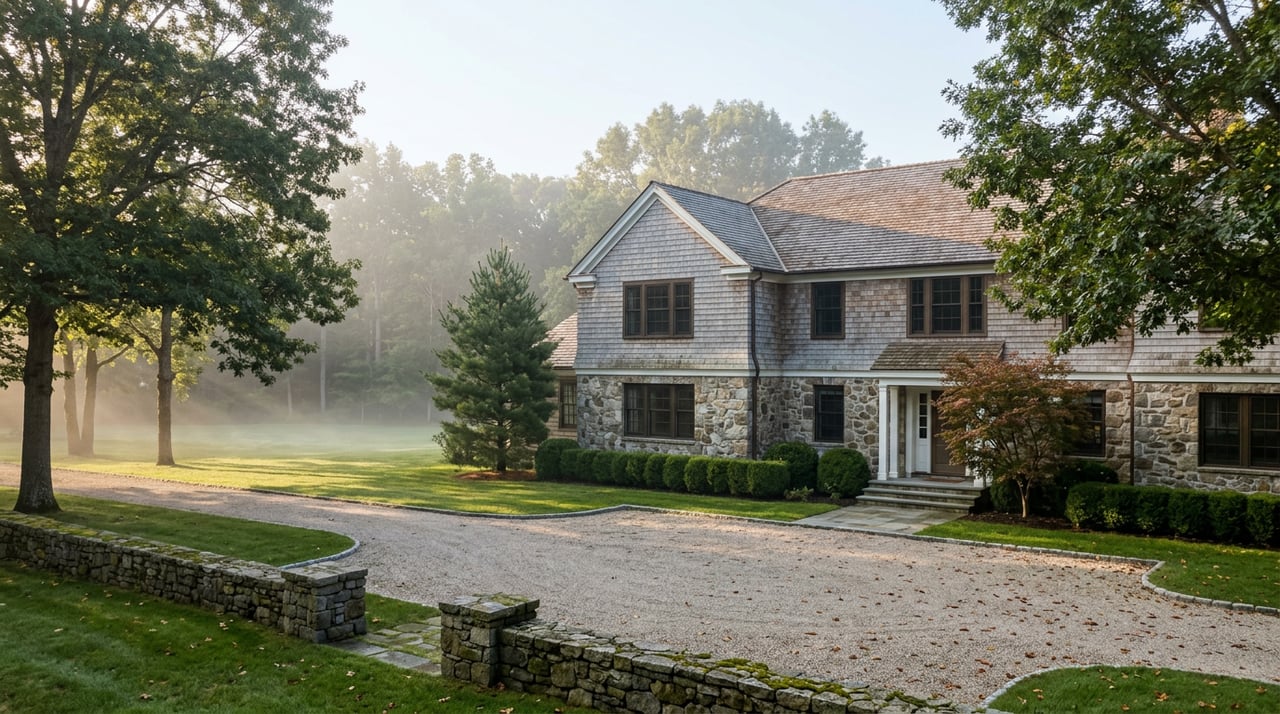
The result is a town built around land rather than density. Harding still contains two unincorporated villages, Green Village and New Vernon, both tracing back to colonial-era settlement, and the acreage requirement around them means a buyer's dollar in Harding is mostly purchasing space: pasture, tree cover, setback from the next roofline. In a rail-adjacent town like Short Hills, the same dollar is mostly purchasing proximity. Neither is a better use of money. They're different products wearing the same currency.
No Meter, No Main
Here is the part of the ledger that rarely makes it into a listing sheet. Most Harding properties are not connected to municipal water or sewer. Per the township's own environmental resources documentation, the majority of residents draw from private wells, with only a small portion of the town served by the Southeast Morris County Municipal Utilities Authority. Septic systems, meanwhile, fall under the jurisdiction of the Harding Township Board of Health, which reviews design, capacity, and approvals for every property that relies on one.
That changes what a buyer inherits at closing, and what a seller needs to disclose and maintain. A five-acre lot with a private well and septic field comes with obligations that a sewered, metered property in Short Hills simply doesn't have:
- A well pump and pressure tank with a finite service life, typically replaced every 10 to 15 years
- A septic field that needs periodic pump-outs and, eventually, replacement, with siting constrained by soil type and lot topography
- A backup generator, standard in most Harding homes, because well pumps and septic pumps both fail the moment the power does
- Test pits and soil evaluations required before any new construction or major addition, since septic capacity has to be verified before the township will issue a permit
None of this makes Harding a harder place to own a home. It makes it a different kind of ownership, one where infrastructure costs sit with the homeowner instead of the municipality. The lower purchase price isn't a discount. Some of it is a deposit toward systems a Short Hills buyer never has to think about.
The Station That Isn't There
The second piece of the gap is the one every commuter feels before they feel the property tax bill. Harding has no train station of its own. The nearest options are in Madison or at Morristown's Convent Station, and from there the ride into New York runs roughly 55 to 70 minutes with a connection, at a monthly pass cost of around $320. Short Hills, by contrast, sits directly on the Morris & Essex Midtown Direct line, with a one-seat ride into Penn Station that many riders complete in about 35 minutes.
That difference is priced into both markets, and it explains more of the gap than acreage alone. Direct rail access is one of the most consistently capitalized amenities in the entire New York commuter belt. Towns that have it trade at a premium over towns that don't, holding lot size and home quality roughly constant. Harding's lower median isn't just about septic systems and five-acre zoning. It's also the market doing exactly what it always does with commute time: charging for the minutes you save and discounting the ones you spend in a car before you ever reach a platform.
| Harding Township | Short Hills | |
|---|---|---|
| 2026 median sale price | ~$1.85 million | $2.1M–$2.75M (varies by source) |
| Typical days on market | ~42 days | Under 30 days, most trackers |
| Water and sewer | Private well; septic under Board of Health | Municipal water and sewer |
| Minimum residential lot size | Up to 5 acres in some zones; RR-zone subdivisions average 5, floor of 3 | Varies by section, generally under 1 acre |
| Nearest direct NYC rail | None; connect via Madison or Convent Station | Midtown Direct, on-site |
| Commute time to Penn Station | ~55–70 minutes with connection | ~35 minutes, one seat |
Why Harding's Homes Take Longer to Sell
The 42-day average isn't a sign of weak demand. It's a sign of a thin, specific buyer pool matching against a thin, specific supply. There are only so many five-acre parcels with private infrastructure in Morris County, and only so many buyers who actually want the trade-offs that come with them, the well maintenance, the septic inspections, the longer commute. When that pool is small on both sides, listings take longer to clear even when every home that does sell finds a serious, motivated buyer. Short Hills, with a larger and more homogenous buyer pool chasing rail access and top-rated schools, clears faster almost by definition. Speed of sale here measures market thickness, not market health.
What This Means If You're Comparing Towns
If you're weighing Harding against a rail-served town like Short Hills, Summit, or Millburn, the honest comparison isn't median price against median price. It's total cost of ownership against total cost of ownership, factoring in what each town asks you to maintain yourself versus what the municipality handles for you. A well flow test, a septic inspection, and a generator installation are not exotic expenses in Harding. They're closing-table conversations that belong in the same spreadsheet as the mortgage estimate.
The upside runs the other direction too. Land, privacy, and a genuinely rural feel less than 35 miles from Manhattan are difficult to manufacture anywhere else in this part of New Jersey, and Harding's zoning ensures that scarcity holds. For a buyer who wants acreage more than a one-seat train ride, that's not a consolation prize. It's the entire point of choosing Harding in the first place.
A Few Questions Worth Answering Directly
Does any part of Harding have public water? A small portion of the township is served by the Southeast Morris County Municipal Utilities Authority. Most residential properties rely on private wells.
Is there any train station inside Harding Township? No. The closest NJ Transit options are in Madison and at Morristown's Convent Station, both requiring a short drive before the ride into Penn Station begins.
Does Harding's lower median price mean it's a weaker market than Short Hills? No. It reflects a different housing product, five-acre lots with private infrastructure instead of sewered, rail-adjacent parcels, not a difference in demand or desirability.
If you're weighing land against commute time, or trying to price out what a well-and-septic property will actually cost you to own over the next decade, that's exactly the kind of conversation worth having before you write an offer. New Jersey Luxury Real Estate Group knows both sides of this market, the acreage towns and the rail towns, and can walk you through the real math behind either one. Start Your Next Chapter when you're ready.